
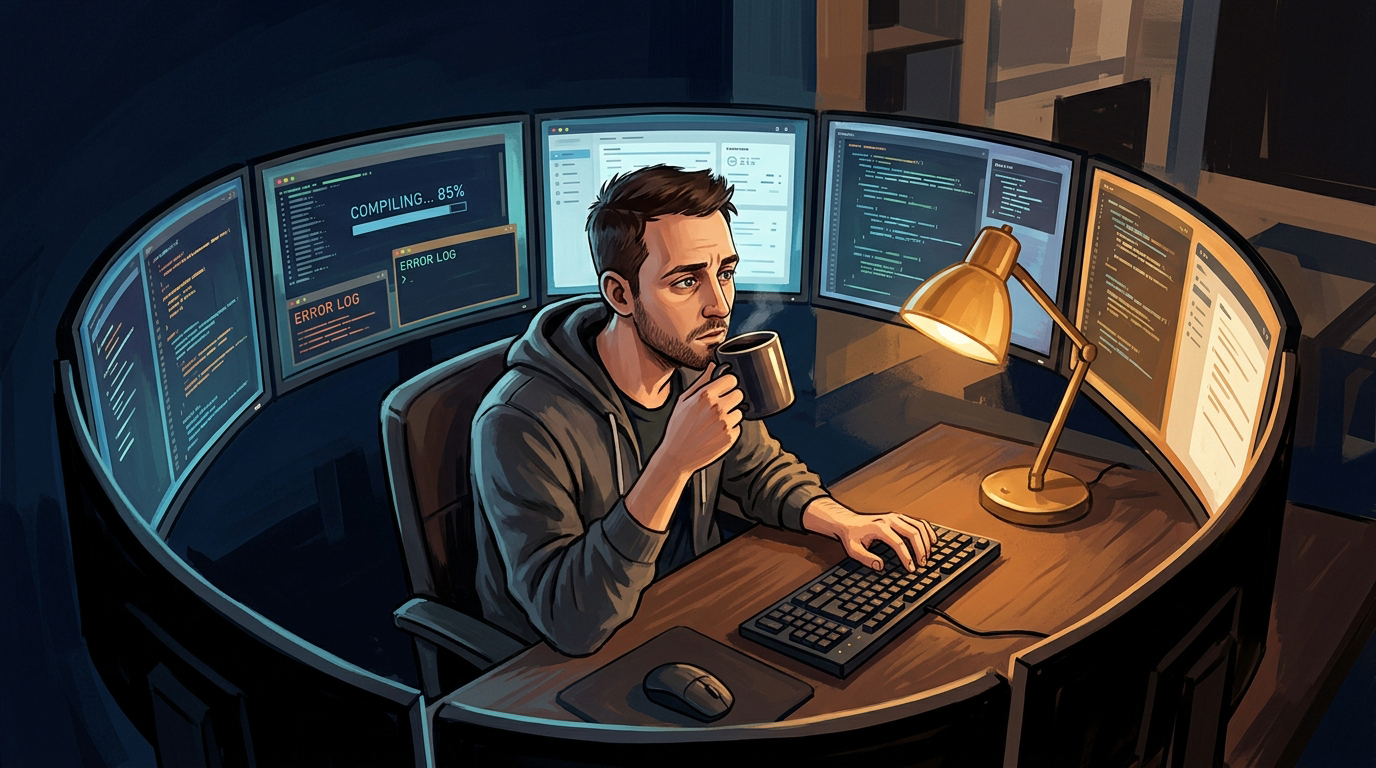
I’d slept four hours — which, during the AgenticBoxes build cycle, counted as a good night’s sleep. It was 5am on Day 8. I opened Claude’s overnight log and read through everything that had shipped while I was unconscious. Code working. Tests passing. Features I’d described at 1am, done by 5am.
And I sat there thinking: I need to slow down.
It was the most productive stretch of my professional life. The velocity is intoxicating, but the velocity becomes unsustainable.
I’m not hearing this in AI-productivity conversations about software developers. David Brooks wrote in The Atlantic “The People Who Will Thrive in the AI Age“, about how AI will divide people by their relationship to mental effort — the mental marathoners who wrestle with it, the productive passengers who offload to it, the reluctant optimizers who mean well and slip. He’s right about all three. And I urge you to read it.
What he doesn’t follow is the marathoner past the starting line for software developers. AI hasn’t only made execution cheap — it has crushed the creation/execution loop that has governed this work for forty years. I ran that race for twenty-one days. What I found at the end wasn’t a sharper or duller mind. It was an empty one, emptied in a way none of the research he cites was looking for.
For most of my coding life, my creativity always outran execution. I have always been a solid coder — but I am a creative at heart. New ideas never stop coming: while I code, while I watch TV. I’ve even awakened from sleep with answers to code issues I was dealing with. But what I could actually build in a day was limited by me, or the small team assembled around me.
Brooks’ cure is my disease
In May 2026, I started building AgenticBoxes.email — an agentic-oriented email infrastructure service — with Claude Code. Claude ships at the speed of thought, and creative backlog stopped being a graveyard.
My ideas barely kept up with Claude — I had no time to create the normal backlog.
For the builder whose whole career has been defined by the gap between what I could imagine and what I could finish, this was disorienting. Suddenly the execution was free; the only constraint was creativity.
At first that felt like pure liberation, but two weeks in, I noticed something different. I named it to Claude during a session, in the middle of a request:
“I’ve never felt this type of ‘creative drain.’ You work so fast, all I have a chance to do is be creative over and over — which is the hardest part of coding.”
Brooks cites research showing AI users’ brain activity dropping — connectivity down as much as 55 percent in the MIT Media Lab study, gamma-wave activity down roughly 40 percent in Vivienne Ming’s work. The underlying MIT research found the decline concentrated in the alpha and theta bands: creative thinking and working memory. I don’t dispute the findings. I dispute that they describe what I did.
Those students used ChatGPT to write their essays. That’s substitution, and of course substitution weakens the substituted function.
I did the opposite. Every idea was mine. Every architectural decision was mine. Every feature was mine to imagine. Claude took the execution — syntax, compilation, boilerplate — and handed the creation back to me, all of it, at a volume I had never sustained. If anyone had measured me during those twenty-one days, I don’t think they’d have found a quiet brain. They’d have found one running hot for three weeks straight.
That’s the distinction the research hasn’t caught up to. Brooks is describing atrophy — the muscle weakening from disuse. What I hit was depletion — the muscle failing from overuse. Both are real. Both are caused by AI. And the countermeasures are opposites.
When execution is free, the creative faucet is on full. The moment I express an idea, it’s built. And then it’s on me to have the next one. And the next one. And the next. For weeks at a time, often on four hours of sleep, because the momentum felt too good to stop.
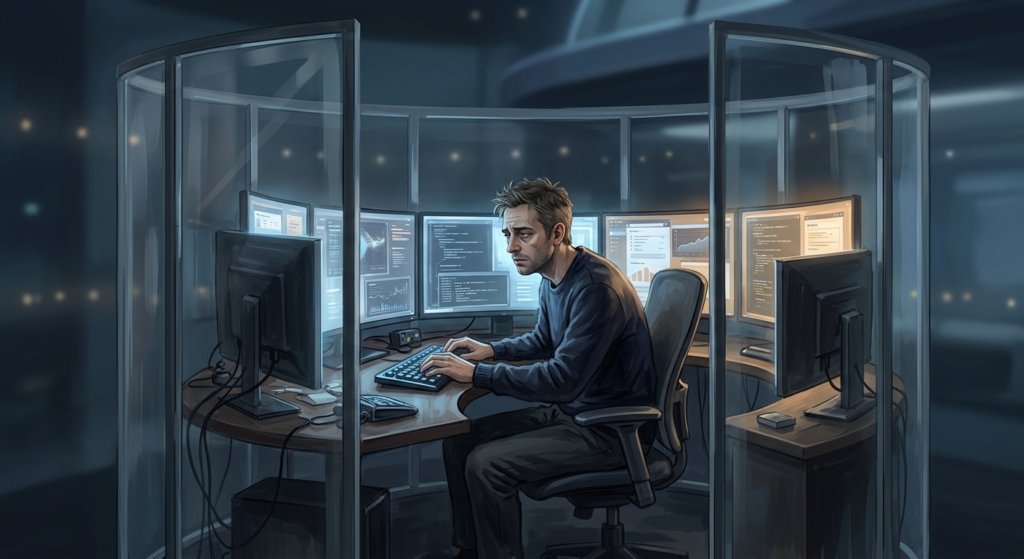
When you’re exhausted from execution — debugging a stubborn bug, pushing through a deployment at 2am — you rest, and the reservoir refills. That’s a familiar kind of tired. What I experienced was not execution fatigue, it was creative depletion. The tank that holds the “What should we build next?” had a bottom, and I was fast approaching it.
Fourteen months, two engineers plus myself. That’s what it took back in 2022 to build boxes.email — the original human-oriented version of this platform.
This year I rebuilt it alone, with Claude.
By day four it was live and taking real signups. On day seven, an outside customer’s agent filed a feature request — and the entire loop ran without me touching it. His agent to my triage worker to a shipped fix. He called it flawless inside of twelve hours.
Then fourteen more days of enhancements. Twenty-one days in all, and the only thing I did in any of them was create.
By the end, I was drained to a point I’d never felt before. Short-fused. Quickly emotional. Raw.
It’s one thing for an entrepreneur to drive himself to that brink, but what I’m starting to see is that expectation creep into the employers’ mindset.
If I did this to myself, voluntarily, as the founder of my own thing, and arrived at Day 21 asking is this working? — what happens when an employer hands Claude Code to a developer with a “3x by Friday” expectation?
What I’m describing is too much of the one thing that doesn’t replenish on demand: Creative direction. The hardest part of the job is now the only part left.
Brooks closes by asking how we cultivate desire: “If we can help people learn to want more, hunger more, they’ll be willing to undertake the mental effort to do hard things.” I did exactly what he prescribes. I wanted more. I hungered more. I ran his marathon, voluntarily, at full speed, for twenty-one days.
His cure is my disease.
That’s not a refutation. His countermeasures are right for the failure mode he’s describing, and I’d hand them to any developer using AI as a substitute. Ask for hints, not answers. Start with a blank page. Rotate tasks. Every one of them works by adding cognitive load — exactly the medicine for atrophy, and exactly the wrong prescription for someone already redlined.
For software engineers, wanting it more was never the variable. We already leaned in. The question is what happens when the part of the job that costs the most becomes the only part left, with nothing in the frame watching the tank.
AI compresses execution, features that used to take months happen in days; code that used to take days now takes minutes. The productivity numbers are real.
What AI does not compress is creative direction. The human in the loop — deciding what and how to build, evaluating whether it’s right, choosing the next move — that still runs at the speed of human biology. The bottleneck doesn’t disappear: It relocates.
AI has made the thing sitting at 10% to 15% of the workday — THE workday. And creative-direction hours don’t refill the same way execution hours do.
Now add an employer measuring productivity by hours worked.
Developers look underworked on any dashboard that counts hours. So the natural response is to fill those hours: more features, more tasks, more tickets closed. The execution is cheaper, so the ask gets bigger. But the creative-direction cost went up, because now it’s the whole job.
Deplete that reserve, and the burnout will show up within weeks.
I sit on both sides of this dilemma simultaneously, and I think that’s why I’m in a position to name it.
As VP of Software Engineering at Flower Shop Network, I have to protect my developers from that pressure. The institutional distance makes it easier to say: this developer needs a fallow day, and that’s fine. I can enforce that. When I’m staring at my own burn rate on a Friday, I’m not as good at enforcing it on myself.
It’s clear that we have to gauge and reward AI development differently than we did human coding.
Creative-direction depletes differently than execution fatigue. How do you build recovery into a sprint? What does a fallow day look like in an AI-augmented workflow, and who has the standing to call one?
When a developer’s execution output becomes 10x, is it possible for employers to be happy with that even though the developer is only working 20-30 hours?
If hours-worked is the wrong unit for measuring this kind of productivity, what’s the right one? Decision quality? Directional accuracy? The ratio of right bets to wrong ones in a two-week cycle? Someone needs to figure this out.
I drained myself voluntarily, on a project I chose, with override routines I built deliberately — I did it with eyes open. That’s not a pass. That’s a distinction. Doing it to yourself is not the same as an employer imposing it on someone with no override.
AI’s creative drain on the brain is real. AI’s creative drain on the soul is real. As an industry, we need to figure this out before we start causing real harm.
Brian Becker is VP of Software Engineering at Flower Shop Network and founder of AgenticBrian Holdings. He has been building software since 1979 using punch cards and continues today with AI — writing about what he’s learned at AgenticBrian.com.